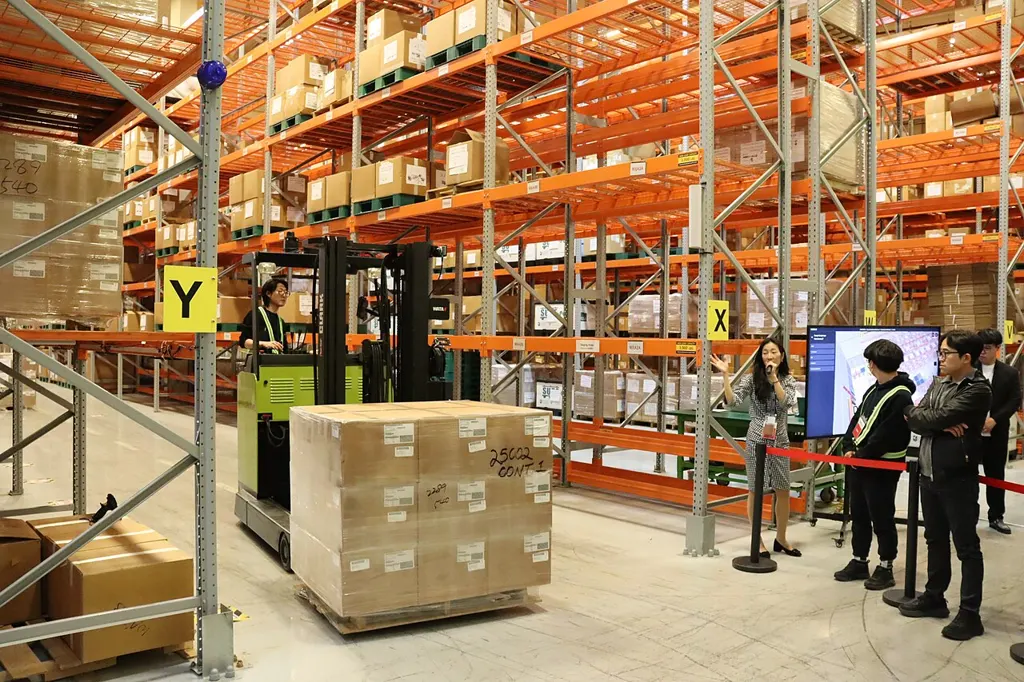
Why this is one of the first things warehouses ask for
Forklifts and people share aisles in almost every warehouse. Most incidents are preceded by near-misses that nobody records, because nobody saw them or there was no easy way to report them. A camera system that notices those moments gives you something you rarely have: data about risk before an accident happens.
It is also a good first vision project because the cameras are often already there, and the outcome is easy to explain to everyone from the floor to the board.
The demo version takes an afternoon
Take a photo like the one above, run an off-the-shelf detector or a vision-language model, and you get boxes around the forklift and the people. Measure the gap between boxes and you have a "near-miss detector".
It looks convincing. It is also wrong in all the ways that matter on a real floor: boxes on a 2D image don't tell you real distance, people partly hidden behind pallets get missed, and a person standing still next to a parked forklift is not a near-miss.
What production actually needs
To be something a safety manager trusts, the system needs a few more layers:
- A model trained or fine-tuned on your floor: your forklift types, your lighting, your camera angles, people in high-vis and without it.
- Tracking across frames, so the system knows it is the same forklift moving towards the same person, and how fast.
- Floor calibration, so pixel distances become real distances, and zones (pedestrian walkways, crossings, loading areas) are drawn on the floor plan.
- Rules that encode what a near-miss actually is: moving forklift, closing distance, within a zone, for long enough.
- A review step, where flagged clips are checked before they count, so the numbers stay credible.
Edge or cloud, and privacy
This kind of system usually runs on a small GPU box on site, close to the cameras, so video never has to leave the building and alerts are fast. Only events and short clips go to a dashboard.
It should not identify people. The point is where and when risk happens, not who. I design these systems so faces are never stored and reports are about zones and times, which also makes the conversation with staff and works councils much easier.
What you get out of it
In the short term: alerts when a near-miss happens, and short clips for toolbox talks. In the long term, the more valuable part: a map of where and when near-misses cluster, so you can change layouts, add barriers, or adjust traffic rules and then see if it worked.
Where to start
Start with one or two existing cameras over your busiest crossing. Record a few weeks, build the system on that footage, and run it with a person reviewing every event before anyone relies on it. You can try the photo demo above with a photo of your own floor to see which other ideas come up for your space.